Vertex Learning Solutions


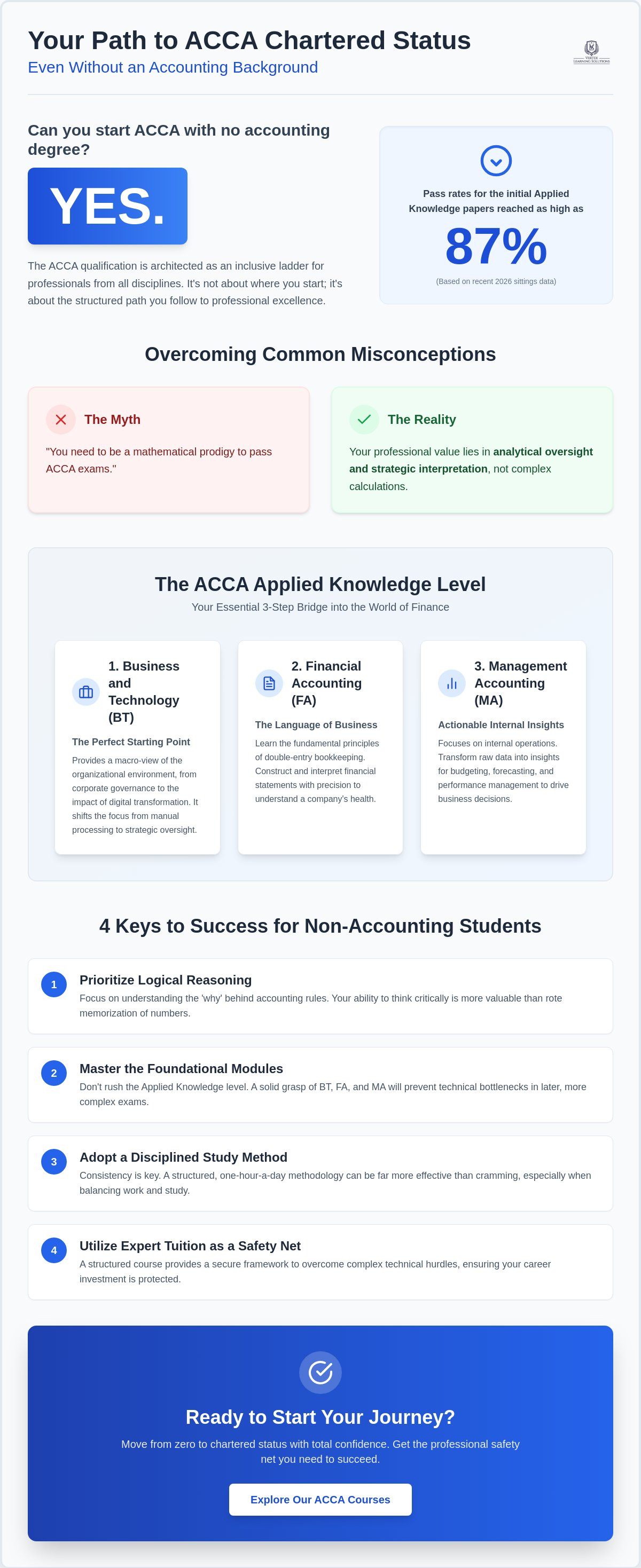
What if your lack of a finance degree wasn't a barrier, but actually a strategic blank slate for your career? While many assume that a background in ledger entries is a prerequisite, the reality is that the ACCA qualification is architected as an inclusive ladder for professionals from all disciplines. In fact, pass rates for the initial Applied Knowledge papers reached as high as 87% in recent 2026 sittings. This data proves that starting ACCA with no accounting background is not just possible; it's a highly structured path to professional excellence.
It's natural to feel a sense of trepidation when facing complex regulations or worrying about how you'll measure up against accounting graduates. We recognize that you need more than just a syllabus; you need a professional safety net and a clear trajectory. This guide provides the definitive roadmap for your transition into high-level finance, ensuring you have the tools to move from zero to chartered status with total confidence. We'll explore the foundational papers that bridge the knowledge gap, the 2026 entry requirements, and the support systems available to protect your career investment.
Key Takeaways
- Understand why logical reasoning and strategic thinking are more vital for ACCA success than advanced mathematical prowess.
- Explore how the three foundational Applied Knowledge modules—BT, MA, and FA—serve as a structured bridge for those without prior financial education.
- Learn why starting ACCA with no accounting background can be a strategic advantage when paired with a disciplined, one-hour-a-day study methodology.
- Identify how expert tuition provides a secure framework to overcome complex technical hurdles that often stall self-study efforts.
Table of Contents
Can You Start ACCA with No Accounting Background? (The 2026 Reality)
The Association of Chartered Certified Accountants (ACCA) stands as a global professional gateway accessible to any degree holder, regardless of their prior field of study. Many prospective candidates hesitate, fearing that starting ACCA with no accounting background requires a mastery of advanced calculus or years of ledger experience. This is a fundamental misconception. The 2026 finance landscape is shifting rapidly. Organizations now actively seek professionals with diverse backgrounds to navigate the complex intersection of fiscal policy, risk management, and digital transformation. The qualification is architected as an inclusive ladder, taking you from basic principles to strategic mastery through a meticulously structured curriculum.
The "Maths Myth" and Other Common Misconceptions
Accounting is a discipline rooted in business logic and regulatory frameworks, not just repetitive number crunching. You don't need to be a mathematical prodigy to succeed. Modern finance relies on sophisticated software for calculations; your professional value lies in analytical oversight and strategic interpretation. Skills like logical reasoning, precise communication, and technical literacy translate directly into the exam room. Starting ACCA with no accounting background often provides a unique advantage, as you approach financial problems with a fresh, multidisciplinary perspective that seasoned accountants might overlook.
Entry Routes for Non-Accounting Graduates
Most non-accounting graduates enter the qualification at the Applied Knowledge level. This stage provides a secure foundation through modules like ACCA Business and Technology (BT) and Financial Accounting (FA). If your previous degree has any overlap with business or law, you might be eligible for certain exemptions. It's a prudent first step to verify your status through the official ACCA calculator to optimize your entry path. For those without a degree, the Foundation level offers an alternative entry point, ensuring the professional protective net is available to everyone with the drive to succeed.
The ACCA Applied Knowledge Level: Your Essential Bridge
The transition into high-level finance requires a robust structural foundation. For those starting ACCA with no accounting background, the Applied Knowledge level serves as this critical infrastructure. It's not merely a series of introductory exams; it represents a comprehensive immersion into the professional standards of the industry. This stage is designed to neutralize the initial learning curve, ensuring that candidates from non-financial disciplines gain the same conceptual depth as those with prior degrees. This ACCA Applied Knowledge framework is recognized globally as the industry standard entry point for aspiring professionals.
Success at the later Applied Skills and Strategic Professional levels depends entirely on the stability of this foundation. Rushing through these modules can lead to technical bottlenecks later in your career. By mastering these three pillars, you ensure that your progress remains steady and your professional integrity remains uncompromised.
Business and Technology (BT): The Perfect Starting Point
Most career switchers find ACCA Business and Technology (BT) to be the most logical starting point. This module provides a macro-view of the organizational environment, covering everything from corporate governance to the impact of external economic factors. In 2026, the curriculum heavily emphasizes how digital transformation and automation are reshaping modern accounting roles. It shifts the focus from manual processing to strategic oversight, making it highly accessible for those with backgrounds in management, tech, or the humanities.
Financial Accounting (FA) and Management Accounting (MA)
Financial Accounting (FA) is where you learn the "language of business." It takes you through the fundamental principles of double-entry bookkeeping, ensuring you can construct and interpret financial statements with precision. Management Accounting (MA) complements this by focusing on internal operations. You'll learn how to transform raw data into actionable insights for budgeting, forecasting, and performance management. Together, these modules provide the quantitative and qualitative tools necessary for starting ACCA with no accounting background and thriving in a competitive corporate landscape.
For those seeking a structured environment to master these concepts, exploring comprehensive tuition options can provide the professional protective net needed to ensure first-time exam success.
4 Success Strategies for Non-Accounting Students
Approaching a professional qualification from a different discipline requires a specific tactical shift. When you're starting ACCA with no accounting background, your primary objective is to build a mental framework that supports technical accuracy and strategic oversight. It's not about the volume of hours spent reading; it's about the precision of your study methodology. Success in 2026 depends on your ability to leverage digital tools while maintaining a disciplined, consistent routine that protects your career trajectory.
One of the most effective habits you can adopt is the "Consistent Progress" rule. Dedicating just one hour every single day creates a powerful compounding effect on your knowledge retention. This approach is far superior to attempting a ten-hour marathon on a weekend, which often leads to cognitive fatigue rather than genuine mastery. You should also utilize digital resources, such as recorded lectures, to revisit complex concepts at your own pace. This flexibility allows you to pause and reflect on technical details that accounting graduates might take for granted.
Bridging the Jargon Gap
Technical terminology acts as the first significant barrier for career switchers. To overcome this, create a personal finance glossary to internalize professional language. You'll find that these accounting exam study tips are essential for building the confidence needed to tackle scenario-based questions. Prioritize active learning by engaging with interactive practice questions early in your preparation. This shift from passive reading to active problem-solving is what ensures you're ready for the rigours of starting ACCA with no accounting background.
Structuring Your Study Environment in 2026
Balancing a full-time career with a professional qualification requires a flexible yet disciplined framework. Modern online platforms allow you to integrate learning into your daily life without compromising your current responsibilities. While recorded content offers necessary flexibility, simulating a classroom environment through live sessions provides the professional accountability required for long-term commitment. This structured approach ensures you don't just study, but actually progress toward your goal with total certainty.
Secure your professional future by choosing a comprehensive study package specifically designed to support non-accounting graduates through every stage of the journey.
Why Expert Tuition is Your Professional Safety Net
Attempting to navigate a global professional certification alone often leads to unnecessary friction and technical stagnation. While self-study appears cost-effective, those starting ACCA with no accounting background frequently encounter conceptual bottlenecks that can derail their career trajectory. Without the professional intuition provided by a prior finance degree, certain regulatory frameworks or accounting principles can seem impenetrable. Expert tuition provides the necessary protective net, transforming these obstacles into structured learning opportunities and ensuring your progress remains stable.
The Vertex (VLS) methodology is specifically engineered to support career switchers by combining recorded flexibility with live tutor accountability. This hybrid model ensures you can study at your own pace while remaining within a disciplined framework. If a complex concept in Financial Accounting feels impossible to grasp, instant WhatsApp support allows you to resolve doubts immediately. This prevents the "study paralysis" that often occurs when a candidate feels isolated. With pass rates for Applied Knowledge papers reaching as high as 87% in the March 2026 sitting, it's clear that the right support system makes the qualification entirely achievable.
The Value of Active Tutor Support
Having a professional mentor to answer even the most fundamental questions is vital for building confidence. Weekly live sessions simulate a classroom environment, fostering the engagement needed to move from a passive learner to a proactive professional. This mentorship helps you look beyond the exam syllabus, teaching you to think like a strategic partner in a complex business environment. It's about developing a strategic mindset, not just memorizing formulas for a one-time assessment.
Choosing the Right Path for Your Career Pivot
Selecting the right entry point is a strategic decision that impacts your long-term success. You can explore ACCA courses tailored to your current level of expertise, ensuring you don't skip the vital foundational steps. For those committed to reaching the Strategic Professional level and becoming a chartered accountant, full access packages offer a stable, long-term roadmap. Starting ACCA with no accounting background is a significant investment in your future; choosing a structured path ensures that investment is fully protected.
Secure Your Professional Future in Global Finance
Transitioning into a high-level finance career is a strategic move that requires a disciplined approach and a robust support system. You've seen that the qualification is designed for accessibility, prioritizing logical reasoning over complex mathematics. By mastering the foundational pillars of Business and Technology, Financial Accounting, and Management Accounting, you build a resilient professional base that remains stable throughout your career. This structured framework ensures that your lack of prior exposure becomes a strategic advantage rather than a barrier to entry.
Starting ACCA with no accounting background is a proven path to global professional recognition when you utilize a structured roadmap. To ensure your success, start your ACCA journey today with Vertex Learning Solutions. Our methodology provides a professional safety net through instant tutor support via WhatsApp, weekly live classroom sessions, and comprehensive exam-focused study notes. This combination of flexibility and accountability is specifically designed to protect your career investment and guide you toward chartered status with total confidence. Your transition into the elite world of finance is entirely achievable with the right strategic partner by your side.
Frequently Asked Questions
Do I need a degree to start ACCA if I have no accounting background?
You don't need a university degree to begin your professional journey. While degree holders in any discipline can enter directly at the Applied Knowledge level, those without a higher education background can start through the Foundations in Accountancy route. This ensures that the qualification remains an accessible ladder for ambitious individuals from all educational paths, providing a secure entry point into the global finance industry.
How long does it take to complete ACCA for a non-accounting graduate?
Most non-accounting graduates complete the 13 required exams within three to four years. Your personal timeline will depend on your professional commitments and the frequency of your exam sittings. Because you must also document 36 months of supervised practical experience to achieve full membership, the qualification is specifically structured to be completed while you're working in a full-time role.
Is the ACCA exam difficult for someone with zero finance experience?
The exams are rigorous but entirely achievable with a structured study plan. When starting ACCA with no accounting background, you'll begin with the Applied Knowledge papers, which had pass rates between 60% and 87% in the March 2026 session. These high success rates demonstrate that the foundational level effectively bridges the knowledge gap for those who are new to the financial sector.
What is the best paper to start with for a non-accountant?
Business and Technology (BT) is widely regarded as the most logical starting point for career switchers. It offers a comprehensive overview of how businesses operate and how the finance function supports corporate strategy, without requiring the technical bookkeeping depth of other modules. Starting with BT allows you to build confidence and understand the exam format before moving into more quantitative subjects like Financial Accounting.
Can I work in accounting while I am still studying for my ACCA?
You can and are encouraged to work in a relevant role while you're studying. Completing the Practical Experience Requirement is a mandatory part of the qualification process. Many organizations actively seek ACCA students for trainee or assistant roles, as it demonstrates a commitment to professional excellence and a willingness to apply theoretical concepts to real-world business challenges.